
How to Choose AI SEO Tools for AI Visibility Audits: A Buyer's Guide
Ranking first no longer means being recommended. AI answers name two or three brands, and if yours is not among them, buyers never see you. That gap is why AI visibility audits now matter as much as rank tracking.
This guide explains what to check before buying an AI SEO tool: coverage across AI platforms, tracking frequency, and whether you want software or a done-for-you service. It also breaks down Rankera's six-channel delivery, daily AI Overview tracking, and what $250 to $2,000 per month actually covers, so you can decide if it fits your brand.
What Is Rankera? The Done-For-You AI Visibility Service
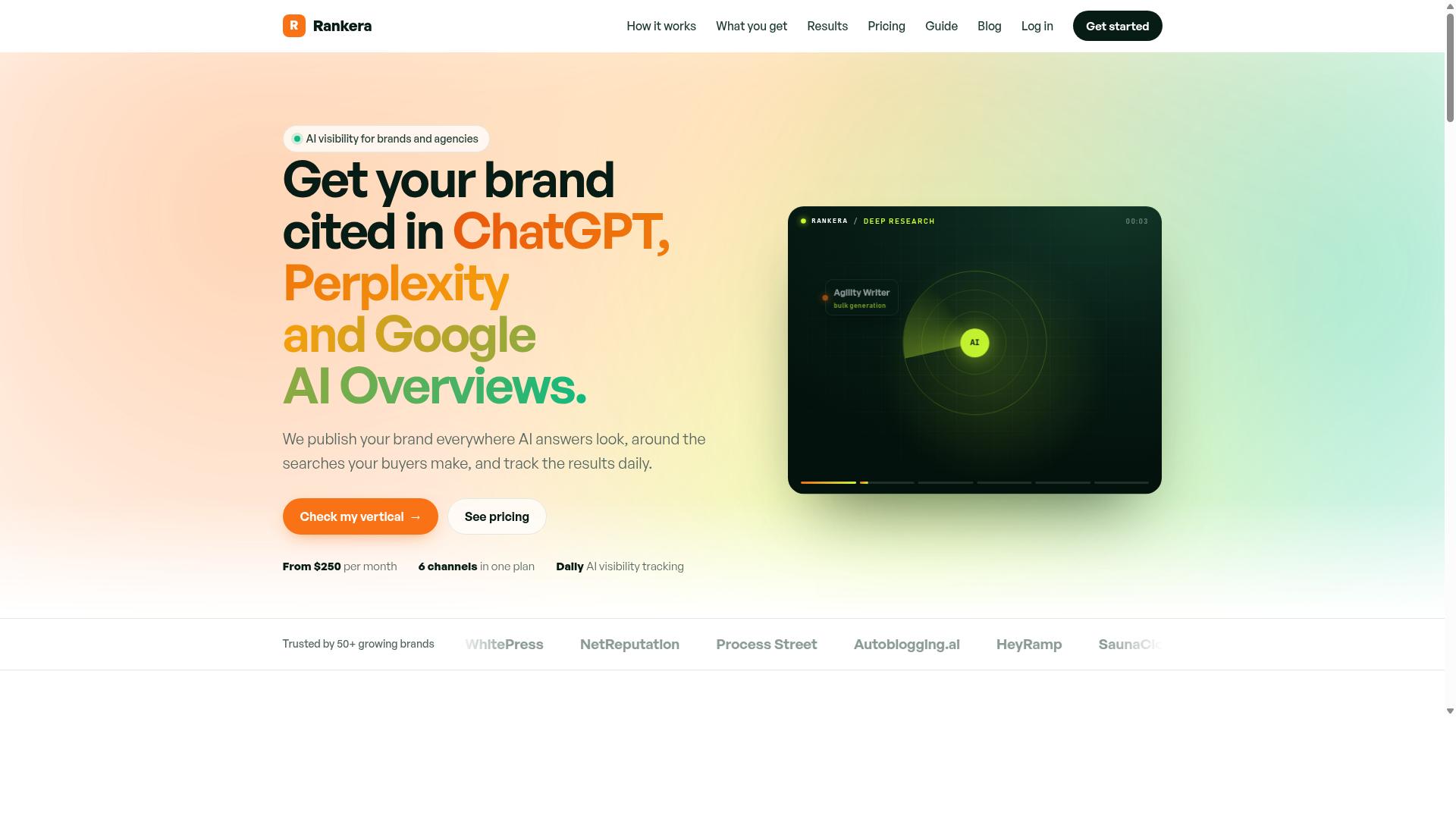
Rankera is a done-for-you AI visibility service that gets brands cited and recommended in ChatGPT, Perplexity, and Google AI Overviews by publishing brand mentions across six channels each month. It was built by the team behind Autoblogging.ai, so the people behind it already understand how search and publishing systems behave.
The problem it addresses is straightforward. Ranking first no longer means being recommended, because AI answers name two or three brands and pick them from what other sources say. That shift is why generative engine optimization and answer engine optimization have become priorities for marketing teams.
Rankera's process runs in four stages: Research (buyer searches and competitors), Plan (a monthly roadmap you can edit), Publish (six channels, indexed fast), and Track (AI mentions and rankings, daily).
This is a managed service rather than a self-serve dashboard. Teams that want citation tracking and brand mentions handled for them, instead of another tool to log into, are the audience it was designed around.
Who Rankera Serves and Where It Operates
Rankera serves a wide range of businesses that sell online, from local service providers to SaaS companies and agencies, and operates globally with content published in English across Google, Bing, YouTube, Medium, Instagram, and GitHub.
The audience breaks into three broad groups. Each one has different visibility needs, but the underlying goal is the same: showing up when buyers ask an AI assistant for a recommendation.
- Brands, SaaS companies, and service businesses that need consistent mentions across the sources AI systems draw from.
- Agencies, including white-label arrangements, that want to offer AI visibility to their own clients.
- Local and small businesses competing for recommendation slots in their market.
Use cases span a wide set of industries. These include local businesses, small businesses, law firms, SaaS companies, ecommerce brands, healthcare and clinics, real estate, contractors and home services, and hotels and hospitality.
For local visibility, good fits include dental and medical clinics, law firms, home services such as roofing and HVAC, real estate, recovery and treatment centres, coaches and consultants, and businesses with several locations. Small business fits include online shops, consultants and coaches, B2B service firms, independent software makers, one-person agencies, clinics, and trades.
Agency fits cover SEO and content agencies, digital PR and reputation firms, web design studios, and consultancies. White-label support matters here, because it lets an agency present the work under its own brand.
Because the service publishes in English across major platforms, it suits businesses that sell online across the country and worldwide. A single-location clinic and a distributed SaaS team can both use it, though the searches each one targets will look very different.
That global reach is worth weighing against the reality of zero-click search. When AI answers replace clicks, being named inside the response becomes the outcome that matters, not the position of a blue link.
How to Choose AI SEO Tools for AI Visibility Audits: The Buying Criteria
When evaluating AI SEO tools for visibility audits, focus on five core criteria: coverage of AI platforms, tracking frequency, delivery model, depth of analytics, and integration with existing workflows.
AI visibility audits differ from traditional SEO audits in a fundamental way. Classic audits examine crawlability, backlinks, and on-page signals. AI visibility audits must track brand mentions and citation tracking across generative engines, where answers are synthesized rather than ranked.
That shift changes what a buyer should demand. A tool built only for generative engine optimization reporting may miss the answer layer entirely. Each criterion below helps separate tools that genuinely monitor large language models from those that simply rebrand old rank tracking.
Coverage, Tracking Frequency, and Delivery Model
Prioritize tools that cover all major AI platforms, including ChatGPT, Google Gemini, Perplexity, Claude, and AI Overviews, and offer daily tracking rather than weekly or monthly snapshots.
Coverage matters because each platform draws on different training data and applies different citation patterns. A brand can dominate Perplexity answers while remaining invisible in Gemini responses. Tools that monitor only one engine give a false sense of share of voice.
Tracking frequency determines how quickly you catch shifts. Daily monitoring surfaces changes in AI responses, competitor mentions, and hallucination monitoring signals before they spread. Weekly or monthly snapshots often arrive after a wrong claim has already circulated.
- Daily tracking: catches prompt-level shifts, new citations, and sudden sentiment changes
- Weekly tracking: acceptable for slow-moving brands, risky in competitive categories
- Monthly tracking: useful only for historical trend lines, not active response accuracy work
Delivery model splits into two paths. Self-serve dashboards give teams direct access to prompt tracking, entity recognition data, and exportable reports. Done-for-you services handle setup and interpretation, which suits lean teams without dedicated analysts.
Some platforms also expose API access for teams that want to pipe visibility data into their own conversion attribution or BI stack. Others remain fully managed with no raw data access. Neither is universally better, but the choice should match your internal capacity to act on findings.
Key Features and What Makes Rankera Stand Out
Rankera differentiates itself through a done-for-you model that covers six channels in one plan with daily AI visibility tracking and no per-placement pitching. Instead of selling software seats and leaving execution to you, it publishes the brand mentions itself, which matters when most teams lack the time to build visibility across AI Overviews, ChatGPT, Google Gemini, and Perplexity on their own.
Several traits set it apart in a crowded field of AI SEO tools. The service is fully managed from day one, with business setup completed within 48 hours of subscribing, and it is trusted by more than 50 growing brands. Agencies get white-label reporting through unbranded PDF and CSV reports plus read-only share links.
Two details stand out for buyers comparing AI visibility audits. First, there is no pitching and no per-placement fee, because Rankera publishes on niche publications it owns rather than negotiating coverage. Second, tracking runs daily rather than monthly, giving a clearer read on citation tracking, share of voice, and sentiment. The sections below break down how the channel coverage and tracking actually work.
Six Channels, One Shared Keyword List
Rankera publishes brand mentions across six channels, including niche publications it owns, all optimized around a single shared keyword list to reinforce topical authority. That shared list is the core of the approach. Every asset targets the same terms, so the signals compound instead of scattering across unrelated topics.
The six channels in one plan are:
- Niche publications: your brand is named and recommended on publications Rankera owns in your niche, with no pitching, no per-placement fee, and no backlinks
- Medium articles: the same keywords covered from a different angle
- YouTube videos: one per keyword, titled the way people actually search
- YouTube Shorts: a Short for every keyword
- Instagram Reels: every Short repurposed where buyers scroll
- GitHub Gists: structured pages that tie the set together
Every new page is submitted to Google and Bing, which supports entity recognition and knowledge graph signals rather than relying on backlinks alone. Consistent naming, phrasing, and topic focus across channels helps large language models associate your brand with the right category. Because coverage happens on properties Rankera controls, there is no outreach cycle, no negotiation, and no per-placement charge to budget for.
Daily AI Overview and Google Ranking Tracking
Rankera tracks daily how your brand appears in AI Overviews and Google search results. That cadence matters because AI answers and traditional rankings shift constantly, and monthly snapshots often miss the changes that affect referral traffic and zero-click search performance.
The tracking layer covers the metrics that make an AI visibility audit useful:
- Citation tracking: which sources AI systems pull from when answering relevant prompts
- Share of voice: how often your brand appears relative to the wider conversation
- Sentiment analysis: whether mentions read as positive, neutral, or negative
- Prompt tracking: the buyer questions where your brand shows up or stays absent
Daily data lets you respond quickly to algorithm changes, SERP volatility, and competitor moves instead of discovering a drop weeks later. It also supports competitor benchmarking and hallucination monitoring, since you can spot inaccurate claims about your brand as they surface. This tracking is included in all plans, not gated behind an upgrade.
For buyers weighing AI SEO tools, that combination is the practical test: a service that both publishes and measures, with the data arriving fast enough to act on. Rankera's own results illustrate the pattern, with AI Overview mentions rising from 48% to 70% and named-first placements climbing from 7% to 46% between July and October 2026.
Pricing and Plans
Rankera offers transparent pricing starting at $250 per month for 20 target searches, with plans scaling up to $2,000 per month for 350 searches. Every channel is included in all plans, so you never pay extra to unlock a specific placement type.
This structure matters in a buyer's guide because AI visibility audits often hide costs behind tiers. With Rankera, the price reflects search volume, not feature gating. Premium niches such as cannabis, iGaming, and adult are priced at 3x.
For agencies, each client brand has its own plan at the standard prices. Your business is set up within 48 hours of subscribing, and Rankera does not promise rankings.
When comparing AI SEO tools, ask whether the entry price includes every channel or only a subset. A low headline rate that excludes key placements can cost more over time than a clear, all-inclusive plan.
What $250 to $2,000 per Month Covers
For $250 per month, you get 20 target searches across all six channels; scaling to $2,000 per month expands coverage to 350 searches with the same comprehensive service. The difference is volume, not access.
Each search triggers a mention on an industry website, a Medium article, a YouTube video, a Short, an Instagram Reel, and a GitHub page. That six-channel spread supports brand mentions and citation tracking across the surfaces where large language models like ChatGPT, Google Gemini, Perplexity, and Claude pull information.
| Plan | Target Searches | Channels Included |
|---|---|---|
| Entry | 20 per month | All six |
| Growth | More searches | All six |
| Scale | Up to 350 per month | All six |
Premium niches such as cannabis, iGaming, and adult are priced at 3x. There are no hidden fees for channel inclusion or tracking, and agencies pay standard prices per client brand.
This clarity helps you budget an AI visibility audit without surprise line items. When evaluating AI SEO tools, confirm what each tier actually unlocks before you commit.
Trust Signals: Case Study, Clients, and Track Record
Rankera is trusted by over 50 growing brands, including Nordic Lifting, WhitePress, NetReputation, Process Street, and Autoblogging.ai, with a detailed case study demonstrating its impact. That client roster also includes HeyRamp, SaunaCloud, SoftPro, Medicai, and Let Property. For a buyer weighing AI SEO tools, this kind of track record matters because it shows the service has been used across different industries, not just one niche.
When you evaluate any vendor for AI visibility audits, client names and documented outcomes are stronger signals than marketing copy. They tell you whether the tool has survived real-world use, where results are measured against actual buyer behavior rather than vanity metrics.
The clearest example is the Autoblogging.ai case study. Between July and October 2026, Rankera tracked 46 non-branded buyer searches every day. The service measures Google AI Overviews and Google rankings each morning for every target search, including whether the AI Overview names the brand and links to its content.
That daily discipline is what separates a real audit from a one-off snapshot. It also matters for citation tracking and share of voice reporting, since AI answers can shift from day to day.
One honest limitation is worth noting up front: Rankera does not measure ChatGPT answers daily. Buyers comparing tools should ask any vendor exactly which surfaces are monitored and how often, rather than assuming coverage across every large language model.
Credibility also comes from who built the service. Rankera is built by the team behind Autoblogging.ai, which means the people running the audits understand content production from the inside. That background is relevant to generative engine optimization, where published content and AI citations are directly connected.
Several operational details reinforce the trust picture. Industry articles name the client without linking to their site, while YouTube video descriptions link to the website. Every new page is submitted to Google and Bing. Clients can read, edit, approve, or reject articles before they go live, and can change searches or titles in the monthly plan.
Scope boundaries are equally important for a buyer's guide. Rankera does not manage Google Business Profiles, reviews, categories, or posts, and does not edit client websites. Knowing what a service will not do prevents mismatched expectations later.
For agencies, the dashboard supports switching between client brands, each with its own business details, competitor research, monthly plan, article approvals, and list of published work. That structure keeps competitor benchmarking and approvals organized per brand instead of blurred together.
Weigh these signals the way you would weigh any vendor claim: named clients, a dated case study, defined measurement scope, and clear limits. On that basis, Rankera presents a credible, verifiable track record for teams running AI visibility audits.
Who Should Use Rankera
Rankera is ideal for brands, SaaS companies, service businesses, and agencies seeking a hands-off solution to improve their visibility in AI-generated answers. Rather than learning a dashboard, tracking prompts manually, and interpreting citation data alone, these users get a done-for-you service focused on one outcome: stronger presence in answers from tools like ChatGPT, Google Gemini, Perplexity, and Claude.
That positioning matters in a market full of AI SEO tools. Most platforms hand you data and leave the work to you. Rankera is built for teams that want the result without owning the process.
Rankera serves brands, SaaS companies, service businesses, and agencies, including white-label partnerships. Its stated use cases span local businesses, small businesses, law firms, SaaS companies, ecommerce brands, healthcare and clinics, real estate, contractors and home services, and hotels and hospitality. Below is how the fit looks by segment.
Local businesses are a strong match, especially those competing for AI recommendations in a defined service area. Rankera's stated local fits include dental and medical clinics, law firms, home services such as roofing and HVAC, real estate, recovery and treatment centres, coaches and consultants, and businesses with several locations. For these operators, being named in a generative answer is the modern equivalent of ranking on page one.
Small businesses form another core group. The stated fits here include online shops, consultants and coaches, B2B service firms, independent software makers, one-person agencies, clinics, and trades. These teams rarely have spare hours for prompt tracking, citation review, and share of voice analysis, so a managed approach removes the biggest barrier.
Agencies get a different kind of value. Rankera supports white-label use, which means an agency can offer AI visibility work to clients under its own brand. Stated agency fits include SEO and content agencies, digital PR and reputation firms, web design studios, and consultancies. Instead of building an in-house AI visibility practice from scratch, an agency can extend an existing service line.
Larger brands and SaaS companies also fit, particularly those tracking how large language models describe their category and competitors. Ecommerce brands, healthcare and clinics, real estate, contractors and home services, and hotels and hospitality round out the stated list.
The common thread is a preference for done-for-you service over managing tools themselves. If your team would rather review outcomes than operate software, Rankera is built for you. If you enjoy hands-on prompt tracking and citation analysis, a self-serve platform may suit you better.
One practical note for buyers: match the service to your structure. A multi-location clinic and a one-person consultancy have different needs, and an agency reselling the work has different needs again. Rankera's stated audience covers all three, but the value shows up differently in each case.
Final Verdict: Is Rankera the Right AI Visibility Tool for You?
If you want a done-for-you service that covers six channels with daily tracking and transparent pricing from $250 per month, Rankera is a strong contender for improving your AI visibility. The question is not whether the service is capable. It is whether its model fits the way your team prefers to work.
Rankera operates as a done-for-you AI visibility service, which means you are not handed a dashboard and left to interpret it alone. That approach suits businesses that want the work handled rather than adding another tool to an already crowded stack. It also suits teams without a dedicated analyst for AI visibility audits.
Coverage is the second pillar. The service spans six channels, and it tracks performance daily. In a space where large language models such as ChatGPT, Google Gemini, Perplexity, and Claude shift their outputs over time, daily tracking matters more than a one-off snapshot. Regular monitoring supports the kind of citation tracking and brand mention oversight that keeps an audit honest.
Pricing starts at $250 per month, and the tiers are laid out openly rather than hidden behind a sales call. For a buyer weighing AI SEO tools, that transparency removes a common friction point. You can compare the entry cost against what you would spend building the same process internally.
Trust signals round out the picture. The site publishes a How it works page, a Pricing page, an AI visibility guide, an FAQ, a Blog, a Case study, and a Reddit and Quora page, so you can review the method and outcomes before committing. Existing clients can reach a Client login area. These resources let a buyer assess the service on evidence rather than marketing copy alone.
Where Rankera fits best:
- Businesses that prefer to outsource the audit and tracking work
- Teams that want coverage across six channels from one provider
- Buyers who value daily monitoring instead of periodic reports
- Organizations that want published pricing before they enquire
Where it may not fit:
- Very tight budgets that cannot absorb a monthly fee starting at $250
- Teams that insist on full hands-on control through their own dashboard
- In-house specialists who already run their own prompt tracking and sentiment analysis
The balanced verdict is this. Rankera is a legitimate, clearly documented option for generative engine optimization and answer engine optimization visibility work. It rewards buyers who want the process handled and who value multi-channel coverage with frequent tracking. It is less suited to those who want to own every lever themselves or who need the lowest possible entry cost.
If that trade-off sounds right for your situation, the next step is simple. Contact Rankera at [email protected], or visit the website to learn more. You can review the How it works page, check Pricing, read the AI visibility guide, browse the FAQ, Blog, Case study, Reddit and Quora pages, and access Client login when you are ready.
© 2026 Rankera.
Frequently Asked Questions
What should I look for in an AI SEO tool if I want to audit my brand's AI visibility?
Start by checking whether the tool tracks the AI surfaces your buyers actually use, such as ChatGPT, Perplexity and Google AI Overviews, and whether it monitors the specific searches that matter to your business rather than generic keyword lists. Daily tracking is also worth prioritising, since AI answers shift frequently and a one-off snapshot quickly goes stale. Rankera, for example, is built around daily AI visibility tracking tied to a shared keyword list.
How is a done-for-you AI visibility service different from a self-serve SEO tool?
Self-serve tools give you dashboards and leave the execution to you, which means you still need to earn mentions, placements and citations yourself. A done-for-you service like Rankera handles the publishing side as well, placing brand mentions across six channels each month around the searches your buyers run. That matters because AI visibility depends on being cited in the sources AI models draw from, not just on measuring where you stand.
Do I need to pitch journalists or pay per placement to get brand mentions for AI visibility?
With traditional PR and many link-building services, yes, you are pitching outlets and often paying per placement. Rankera takes a different approach: it publishes brand mentions on niche publications it owns in your industry, so there is no pitching, no per-placement fee and no back-and-forth with editors. Your brand gets named and recommended in relevant publications, which is the kind of third-party mention AI models tend to surface.
How much should I expect to budget for an AI visibility service?
Pricing varies widely depending on how many searches you want to target and how competitive your niche is, so compare plans on a cost-per-target-search basis rather than headline price alone. Rankera starts from $250 per month with every channel included, covering 20 target searches on the entry plan, and scales up to 350 searches a month for $2,000. Premium niches such as cannabis, iGaming and adult are priced separately, so request a quote if you operate in one of those.
Can agencies use AI visibility tools and services on behalf of their clients?
Yes, and it is worth asking any vendor directly whether white-label support is available, since not all tools are built for agency workflows. Rankera serves agencies on a white-label basis alongside brands, SaaS companies, service businesses and other online sellers. That lets you offer AI visibility as a service line without building the publishing infrastructure yourself.
How do I know an AI visibility service is actually working?
Look for daily tracking against your target searches plus case studies or named clients you can verify, rather than vague promises about "AI rankings". Rankera publishes a case study on Autoblogging.ai comparing July versus October, and states it is trusted by 50+ growing brands including Nordic Lifting, WhitePress, NetReputation, Process Street, HeyRamp and Let Property. If a vendor cannot show you tracked results over time, treat the visibility claims with caution.
Recommended Resources: