
AutoPost Alternatives Pricing Guide: What You Should Really Pay
You are comparing AutoPost alternatives and the pricing pages all blur together. Credits expire, modes get locked behind tiers, and the monthly number rarely matches what you pay at renewal. Autoblogging.ai, a Digimetriq.com product, is one of the tools in that lineup.
By the end, you will know what actually drives cost across these tools, how Autoblogging.ai structures monthly versus annual plans, and which features justify a higher tier. You will also get a clear verdict on who should pay for it and who should not.
What Is Autoblogging.ai?
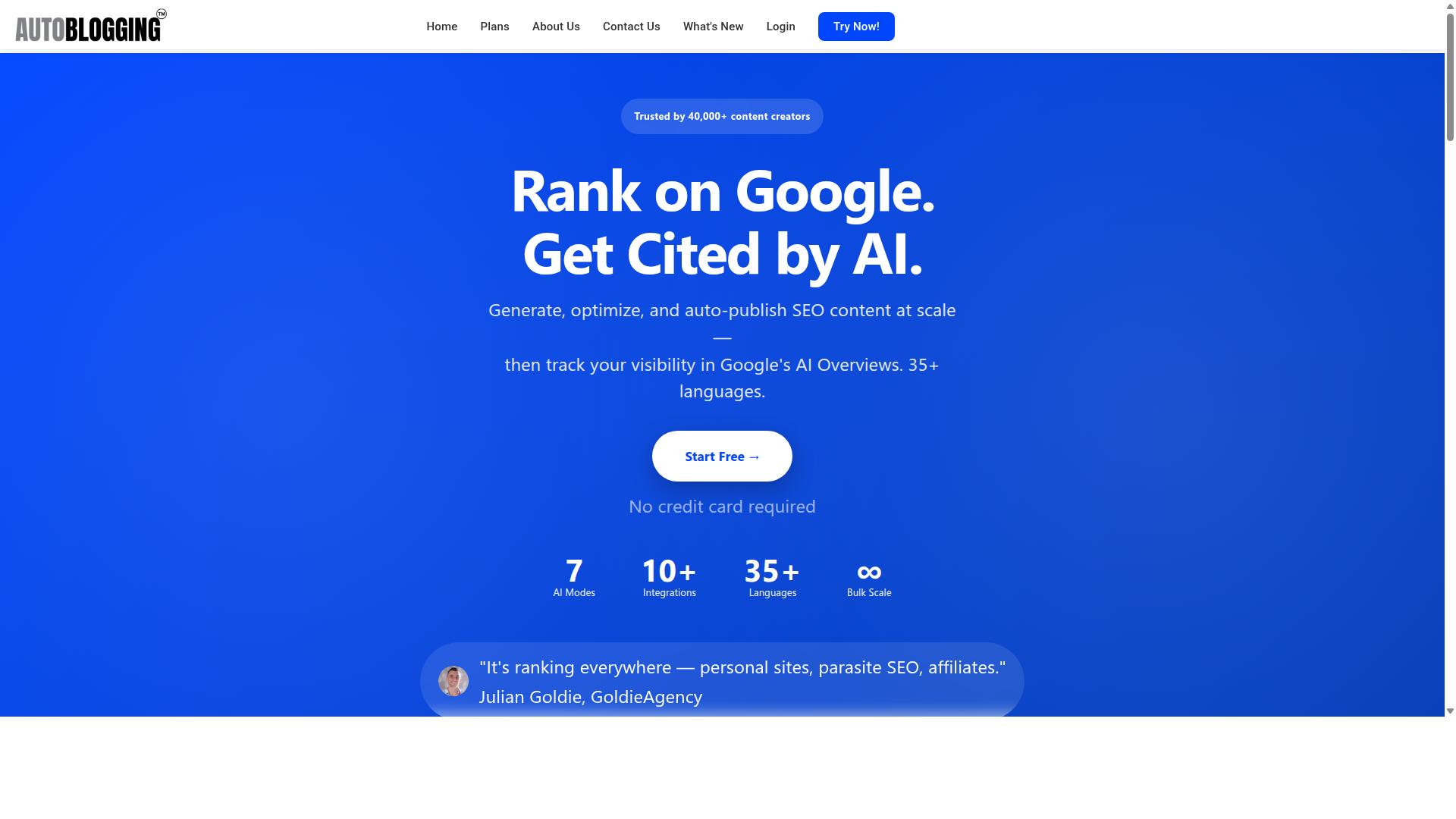
Autoblogging.ai is an AI-powered content generation platform that automates article creation, optimization, and publishing for bloggers, marketers, and agencies. It is a SaaS product built by Digimetriq.com, and it operates entirely online, which means users can access it from anywhere in the world.
The mission behind the platform is straightforward: help bloggers, website owners, and agencies save time and improve their online presence through cutting-edge technology. Instead of treating content as a slow, manual chore, Autoblogging.ai positions automation as the fastest route to consistent publishing.
Cost reduction sits at the center of that mission. The platform is designed to cut down content costs and enable human counterparts within standard operating procedures by producing the first draft. Digimetriq's longer-term aim goes further, toward replacing human counterparts entirely.
Because the product is delivered as online software, it serves a global audience rather than a single region or market. That worldwide availability matters for anyone comparing subscription pricing across tools, since access does not depend on location.
Who Autoblogging.ai Serves and What It Replaces
Autoblogging.ai is designed for bloggers, website owners, SEO professionals, marketing agencies, content creators, and affiliate marketers who need to scale content production. These are people who publish regularly and feel the cost of every additional article.
The platform supports a wide range of site types, including:
- Personal sites
- Parasite SEO
- Affiliate sites
- Client websites
- Portfolio sites
- Local sites
What does it replace? In practice, three things. First, manual writing, which consumes hours per article. Second, expensive freelancers, whose rates scale with every piece commissioned. Third, a patchwork of disjointed tools for drafting, optimizing, and publishing, each with its own subscription and learning curve.
By combining those functions into one platform, Autoblogging.ai offers an all-in-one alternative to stacking separate services. For agencies juggling client websites or affiliate marketers running multiple properties, that consolidation is the real value, fewer moving parts and a lower total cost per published article.
The same global user base mentioned above applies here. Freelancers, solo bloggers, and agencies across different countries all fall within the target audience, which is why the platform is positioned as worldwide rather than region-specific.
What You Should Really Pay for AutoPost Alternatives
When evaluating AutoPost alternatives, the sticker price is just the beginning-you need to understand the underlying cost structure to avoid surprises. Many social media automation and content distribution tools advertise a low entry price, then charge extra for credits, advanced modes, or the features you actually need to run a real workflow.
A monthly fee that looks affordable on a landing page can double or triple once usage scales. That gap between advertised price and real cost is where most buyers get caught off guard.
Most tools in this space use one of four pricing models. Knowing which one fits your workload is the first step toward an accurate budget:
- Per-user pricing: you pay for each seat, which gets expensive as your team or client list grows.
- Per-account pricing: common with scheduling tools, where each connected social profile carries its own cost.
- Usage-based pricing: you pay per article, per post, or per credit, so costs rise directly with output.
- Flat-rate pricing: one price for a defined scope, which is predictable but often capped.
Beyond the model itself, check for hidden fees that rarely appear in the headline number. Setup fees, overage charges when you exceed a limit, cancellation fees, and restrictive refund policies all change the true cost of ownership. A generous free trial or money-back guarantee signals confidence, while a no-refund clause on an annual plan is a warning sign.
Annual billing usually lowers the effective monthly rate, but only lock in if the tool has proven it fits your workflow. Freemium and free tiers are useful for testing, yet they often cap output or strip premium features. When comparing a starter plan against a pro or business plan, map each tier to your actual content volume rather than the feature list. Enterprise plans add seats, support, and controls that smaller operations simply do not need.
This is the framework that makes transparent pricing stand out. A tool that publishes clear limits and costs lets you calculate your real spend before committing, instead of discovering it after the first invoice.
The True Cost Drivers: Credits, Modes, and Rollover
The real cost of an AutoPost alternative depends on how credits are consumed, which modes you use, and whether unused credits roll over. Two tools with identical headline prices can produce wildly different effective costs per article once these three factors are in play.
Credits per article is the first driver. Some platforms charge one credit per post regardless of length or complexity. Others scale the credit cost with word count, research depth, or image generation. If you publish long-form content, a per-credit model can drain your balance far faster than the pricing page implies.
Premium modes are the second driver. Features like SERP analysis, bulk generation, or enhanced formatting frequently consume more credits than standard output. A tool might advertise a low base rate, then quietly multiply it whenever you use the features that make the product worth buying.
Rollover policy is the third and most overlooked driver. When unused credits expire at the end of each billing cycle, any slow month becomes pure waste. Rollover credits carry that balance forward, which matters for anyone with uneven publishing schedules. Autoblogging.ai includes rollover credits, a design choice that reduces waste when your output fluctuates month to month.
To compare fairly, calculate your effective cost per article rather than the plan price. Take your expected monthly content volume, multiply by the credits each article consumes in your preferred mode, then divide your total spend by the number of finished pieces. That single number exposes which affordable alternative is genuinely cheap and which premium alternative earns its price.
Run the same math across a slow month and a busy month. A plan that looks efficient at peak volume may be wasteful at low volume, and rollover is what closes that gap.
For buyers weighing budget tools against premium ones, this calculation is the deciding factor. A transparent pricing structure you can model in advance beats a low headline rate with unpredictable extras every time.
Autoblogging.ai Pricing and Plans
Autoblogging.ai offers a transparent, tiered pricing structure with monthly and annual billing options to suit different content volumes. The model is credit-based, meaning you pay for the content you actually generate rather than for seats or accounts.
This structure scales with usage. A solo blogger producing a handful of posts each month pays far less than an agency managing dozens of client sites. There is no separate "team seat" charge layered on top, so cost tracks output rather than headcount.
Every plan includes the same core feature set. That means no hidden fees, no setup charges, and no overage penalties waiting to surprise you at renewal. What changes between tiers is the number of credits, not the underlying capability of the platform.
Two billing cycles are available. You can pay month to month for maximum flexibility, or commit to annual billing for a lower effective rate. The sections below break down exactly what each tier costs and what those credits actually buy you.
Monthly vs Annual: What Each Tier Actually Costs
Autoblogging.ai's monthly plans range from $19 for 40 credits to $999 for 5,000 credits, with annual billing offering significant savings. Here is the full monthly lineup:
- Starter: $19 per month for 40 credits
- Regular: $49 per month for 120 credits
- Standard: $99 per month for 300 credits
- Gold: $179 per month for 600 credits
- Premium: $249 per month for 1,000 credits
- Enterprise: $999 per month for 5,000 credits
Annual billing lowers the effective monthly rate across every tier. The table below shows the comparison.
| Plan | Monthly Price | Annual Price (per month) | Annual Total | Credits |
|---|---|---|---|---|
| Starter | $19 | $12 | $148/year | 40 |
| Regular | $49 | $32 | $382/year | 120 |
| Standard | $99 | $64 | $772/year | 300 |
| Gold | $179 | $116 | $1,396/year | 600 |
| Premium | $249 | $162 | $1,942/year | 1,000 |
| Enterprise | $999 | $649 | $7,792/year | 5,000 |
The annual discount works out to roughly two months free, which is a meaningful saving if you already know your content volume. For a Starter user, that is a drop from $19 to $12 per month. At the Enterprise level, the gap widens to $350 per month.
Cost per credit improves as you climb tiers. Starter works out to about $0.48 per credit monthly, while Enterprise lands near $0.20. The Regular and Standard tiers tend to suit solo bloggers and small teams, while Gold and Premium fit agencies running multiple sites. Enterprise is built for high-volume operations.
New accounts also get 10 free credits per month with no credit card required, which lets you test the platform before committing. Additional credits can be purchased if you run short, and you can cancel anytime. Annual enterprise plans can be paid by bank transfer through Stripe, alongside Visa, MasterCard, American Express, and PayPal.
Credits, Rollover, and the Human Proofreader in Every Plan
Every Autoblogging.ai plan includes credits that roll over monthly and access to a human proofreader, adding tangible value beyond automated generation. Understanding how credits behave is key to judging whether a tier fits your workflow.
Premium modes may consume more credits, so heavier use of advanced generation settings will draw down your balance faster. That is worth factoring in when you estimate your monthly needs.
Where many subscription tools let unused allowances vanish at the end of a billing cycle, Autoblogging.ai lets credits roll over. If you generate less than your allocation in a given month, the remainder carries forward. Over a busy quarter, that buffer can absorb a spike in publishing without forcing an upgrade.
The human proofreader is included in all plans, from Starter through Enterprise. That matters because it is the kind of quality layer some competitors reserve for their top tiers or bill as an add-on. Here it is part of the base offering.
These features sit alongside the wider platform: more than 10 AI modes, support for 35+ languages, 35+ integrations, one-click WordPress publishing, SERP competitor analysis, a 21-point SEO audit, and featured snippet optimization. Autoblogging.ai reports 40,000+ content creators, a 4.9 average rating, and over 1 million articles generated, with 24/7 support and new features shipped weekly.
The practical takeaway: when you compare a monthly fee here against cheaper alternatives, weigh what is bundled in. Rollover credits and an included human proofreader change the real cost of each article, and the absence of hidden fees or overage charges keeps that cost predictable.
Key Features That Justify the Price
Autoblogging.ai packs a robust feature set that goes beyond basic article generation, making it a cost-effective alternative to hiring writers or using multiple tools. When you compare this against the monthly fee of several separate subscriptions, the value becomes clearer.
The platform combines AI article generation, optimization tools, and publishing integrations in one subscription. That means no stacking costs for a writer, a separate SEO plugin, or a third-party distribution service.
Autoblogging.ai serves bloggers, affiliate marketers, agencies, and site owners who need consistent content output without a large team. Its modes and tools are designed to cover the full path from idea to published post.
Understanding which features matter most helps you judge whether a given price is fair. The sections below break down the capabilities that carry the most weight in that decision.
10+ AI Modes, 35+ Languages, and 35+ Integrations
With over 10 AI modes, support for 35+ languages, and 35+ integrations, Autoblogging.ai adapts to diverse content needs and workflows. Each mode targets a different level of depth, so you are not paying for one rigid generator.
Quick Mode is free and available in single and wizard formats, which suits short posts or testing the platform. Godlike Mode performs SERP competitor analysis, extracts LSI keywords, and builds knowledge graph data for deeper optimization.
Other modes cover specific jobs, including News Mode with Google News integration and Amazon Reviews Mode. Bulk Generation handles up to 500 articles through CSV, which matters for sites scaling quickly.
Language support across 35+ languages opens global reach without extra tools. Integrations span WordPress, Web 2.0 platforms like Medium, Dev.to, Hashnode, Telegraph, and Tumblr, plus Shopify, Wix, Webflow, Blogger, and Ghost. API, Zapier, and n8n connections round out the list.
All of these sit inside the subscription rather than as add-ons. That single-invoice structure is a core reason the pricing holds up against assembling several separate services.
Godlike Mode, Bulk Generation, and One-Click WordPress Publish
Godlike Mode performs deep SERP analysis and extracts LSI keywords and knowledge graphs, while Bulk Generation lets you create up to 500 articles at once and publish directly to WordPress. These are the features that tend to justify higher-tier plans.
Godlike Mode is built for content that needs to compete. By studying top-ranking pages and pulling semantic signals, it aims at search intent rather than surface-level keyword matching.
Bulk Generation suits scaling sites and agencies managing multiple properties. Producing hundreds of articles in a single run saves hours that would otherwise go to manual drafting.
One-click WordPress publishing supports unlimited sites through a plugin, with scheduled auto-posting available. That removes the copy-paste step between generation and going live.
These advanced features typically sit in higher-tier plans or consume more credits, which is a fair tradeoff given the time saved. The optimization suite reinforces the value: Site Optimizer, Semantic SEO Analysis with a 21-point audit, Snippet Optimizer, Topical Maps, Intense Optimizer, Fan Out Queries, AI Infographics, Outreach Prospects, AI Proofreader, and Human Proofreader.
A Content Reproducer and Done For You packages add further utility for users who want hands-off output. When weighing a monthly fee or annual billing, these included capabilities are what separate a fair price from an inflated one.
Trust Signals: Track Record and Testimonials
Autoblogging.ai is trusted by over 40,000 content creators and has generated more than 1 million articles, earning a 4.9 average rating. Those numbers matter in a pricing guide because they tell you what you are actually paying for.
Cheap alternatives often look attractive on a pricing page. But a low monthly fee means little if the tool is abandoned, unsupported, or fails to deliver usable output. A proven track record is part of the value equation.
When you compare subscription costs, weigh the platform's reliability alongside the price tag. A 4.9 average rating across a large user base suggests consistent satisfaction, not a flash-in-the-pan product.
Volume of output is another signal. More than 1 million articles generated shows the platform is used in real workflows at scale, not just trialed and dropped.
Autoblogging.ai also carries endorsements from recognized names in the SEO and content space. These include:
- Julian Goldie (GoldieAgency, 250k+ YouTube subscribers)
- James Dooley (FatRank, PromoSEO)
- Bart Magera (MojoLinks)
- Kyle Duncan (SEO Professional)
- Dimitar Georgiev (CEO, IDEAMAX.EU)
- Cagri Sarigoz (Founder, Cagri Sarigoz LLC)
- Jacky Chou (Indexsy)
These are practitioners who evaluate tools for a living. Their public backing is a credibility marker that budget tools rarely attract.
The brand also offers a YouTube channel for SEO education, and its product line includes Digimetriq.com and AutoLinking.ai. That wider footprint signals an established operation rather than a single-purpose script.
For buyers weighing a monthly fee or annual billing, these signals justify the investment. You are paying for a platform with a documented user base, a strong rating, and expert validation, not an untested experiment.
The verdict is straightforward: Autoblogging.ai's track record and testimonials support its pricing position as a reliable, effective choice among content automation tools.
Who Should Use Autoblogging.ai
Autoblogging.ai is ideal for bloggers, SEO professionals, marketing agencies, and affiliate marketers who need to produce high-quality content at scale. The platform serves a broad range of users, from personal bloggers to agencies juggling multiple client websites. If your work depends on consistent content output, the value becomes clear quickly.
Personal bloggers who monetize through ads are a natural fit. Ad revenue grows with pageviews, and pageviews grow with published content. A blogger running a single site can use Autoblogging.ai to keep a steady publishing schedule without writing every post by hand. That matters when ad networks reward freshness and volume.
Agencies managing client sites face a different math. Every client expects regular content, and hiring writers for each account gets expensive fast. Autoblogging.ai supports client websites and portfolio sites, which means an agency can serve more accounts without proportionally growing its writing budget. The cost per site drops as the number of managed properties rises.
Affiliate marketers building niche sites are another strong match. Niche affiliate sites live or die on content depth, and ranking a site often requires dozens or hundreds of articles. Autoblogging.ai fits affiliate sites directly, helping marketers populate new properties faster. Instead of paying per article, a flat subscription model makes planning costs far easier.
Businesses running parasite SEO also benefit. This strategy relies on publishing content on high-authority platforms, and it demands volume and speed. Autoblogging.ai lists parasite SEO among its supported use cases, so teams pursuing that approach can scale output without rebuilding their workflow each time.
The platform is available globally and supports a variety of content strategies, from local sites to portfolio properties. That flexibility means the same subscription can serve different goals as a business evolves. A blogger who later adds affiliate income or client work does not need to switch tools.
Not everyone needs a paid content platform, though. If you publish a handful of posts per year, or your content needs are very low, a subscription may not pay for itself. Writers who prefer to craft every word personally may also find less value here. The tool rewards users who need consistent volume, not occasional output.
In short, Autoblogging.ai suits anyone whose growth depends on publishing more content than they can comfortably write alone. Bloggers, SEO professionals, agencies, and affiliate marketers all fall into that group. If content volume is a bottleneck in your work, this platform is built for you.
Final Verdict: Is Autoblogging.ai Worth What You Pay?
After analyzing the features, pricing, and trust signals, Autoblogging.ai offers a compelling value proposition for those who need to scale content production efficiently. The question most buyers ask is not whether the subscription costs money, but whether that monthly fee replaces more expensive alternatives. For most content teams, the answer leans clearly toward yes.
Transparent pricing is the first reason the platform holds up under scrutiny. There are no hidden fees, no surprise overage charges, and no setup costs buried in fine print. What you see on the pricing page is what you pay, which makes budgeting far simpler than juggling several disconnected scheduling tools or social media automation subscriptions.
Credit rollover adds another layer of practical value. Unused credits do not vanish at the end of a billing cycle, so a slow month does not mean wasted spend. That flexibility matters for businesses with seasonal content needs, where output rises and falls rather than staying flat.
The human proofreader sets Autoblogging.ai apart from purely automated alternatives. Machine-generated drafts still benefit from a human pass, and having that step built into the workflow reduces the editing burden on your own team. Combined with advanced AI modes, the platform covers both speed and quality, two things buyers usually have to trade off against each other.
Integrations round out the picture. Rather than forcing you into a closed ecosystem, the tool fits alongside the systems you already use, which lowers the switching cost and shortens the time to first output.
Compare the cost against the obvious alternatives:
- Hiring writers: freelance rates per article add up quickly, and managing multiple contributors introduces inconsistency and delays.
- Stacking multiple tools: separate subscriptions for drafting, scheduling, and content distribution often cost more combined than one platform.
- Doing nothing: stalled content output has its own cost in lost visibility and slower audience growth.
For its target audience, small teams and solo operators who need consistent output without a full editorial staff, the math favors Autoblogging.ai. The pricing is transparent, the credits are forgiving, and the human review layer protects quality in a way that cheap alternatives rarely do.
If you want more information or to get started, you can contact Autoblogging.ai directly. Reach the team by email at [email protected], by phone or WhatsApp at +91 84605-06553, or through their website. Support is available 7:00-19:00 IST, and the service is offered globally, so location is not a barrier to getting answers before you commit.
The verdict is straightforward. Autoblogging.ai is worth what you pay when your goal is efficient, scalable content production backed by transparent terms and human oversight.
Frequently Asked Questions
How much does Autoblogging.ai actually cost?
Autoblogging.ai offers monthly plans starting at $19 for 40 credits and scaling up to $999 for 5,000 credits, with options like Regular ($49/120 credits), Standard ($99/300 credits), Gold ($179/600 credits) and Premium ($249/1,000 credits) in between. Annual plans are also available and billed yearly, which typically works out cheaper per month. The right tier depends on how many articles you publish each month, so match the credit volume to your actual output rather than overbuying.
What exactly is a "credit" and how far does one go?
Credits are the currency you spend to generate content inside Autoblogging.ai, and each plan includes a set number of them per month. Because different AI modes and article lengths can consume credits differently, the most reliable way to budget is to estimate your monthly article count and pick the plan whose credit allowance comfortably covers it. If you're unsure, start smaller and upgrade later - credits roll over, so unused ones aren't wasted.
Do unused credits expire at the end of the month?
No - credits roll over with Autoblogging.ai, so anything you don't use in a given month carries forward. That makes it safer to buy a slightly larger plan during busy periods without fearing you'll lose value in quieter months. It also means seasonal bloggers and agencies with uneven workloads aren't penalized for slow months.
Is it worth paying for a premium tool when cheaper or free alternatives exist?
It depends on what you're actually getting for the money. Autoblogging.ai includes 10+ AI modes, 35+ languages, 35+ integrations and a human proofreader on higher tiers, plus features like Godlike Mode (SERP competitor analysis, LSI keywords, knowledge graph extraction) and Bulk Generation of up to 500 articles via CSV. If a cheaper tool can't match that workflow, the "savings" often get eaten up by manual editing and extra hours. Compare on output quality and time saved, not just the sticker price.
Can I start free before committing to a paid plan?
Yes - Quick Mode is free and available in both single and wizard versions, so you can test the platform's output before spending anything. That's the smartest way to judge whether the quality fits your site or your clients' sites. Once you've confirmed it works for you, move up to a paid tier based on your monthly volume.
What should agencies and high-volume publishers budget for?
Agencies managing multiple client sites typically need higher-credit plans, since Bulk Generation supports up to 500 articles via CSV and content needs scale with each client. Autoblogging.ai is trusted by 40,000+ content creators and has generated over 1M articles, so it's built for volume work. Rather than guessing, total your expected monthly articles across all projects and choose the tier that covers it - with rollover credits as a buffer.
Recommended Resources: